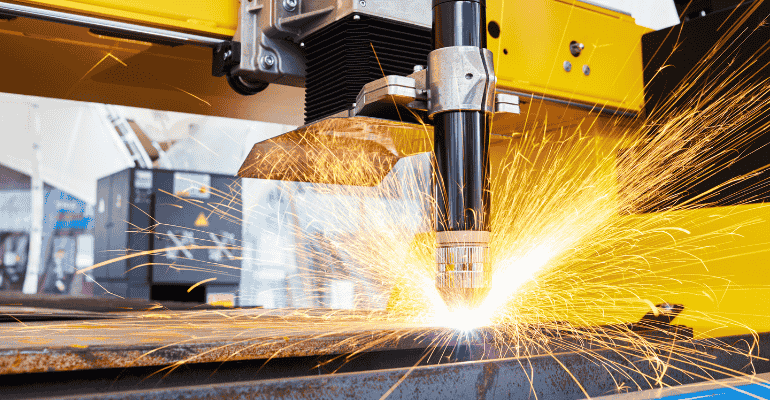
Metal laser cutting in Greater Noida is a precise way to cut metal. It uses a beam of light to melt or burn the metal. When people do this in a workshop, they usually use a machine called a CNC machine. This machine helps them cut the metal correctly. Metal laser cutting is an accurate process, and the CNC machine makes sure of that. The metal is cut using a beam of light, which is good at melting, burning or vaporizing the metal.
Types of Metal Lasers
There are many kinds of lasers, but the industry mainly uses three types of lasers:
Fiber Lasers:
People consider the gold standard for cutting metal. Fiber Lasers are good at this job. They work by using diodes that make light stronger as it goes through glass fibers. Fiber Lasers are very fast. They do not waste a lot of energy. One of the things about Fiber Lasers is that they can cut through metals, like brass, copper and aluminum without hurting the machine itself. This is important because these metals can be tricky to work with. Fiber Lasers make it easy to cut them.
CO2 Lasers:
They use a mix of gases like CO2 and Nitrogen and Helium. CO2 Lasers are good for cutting things that are not metal, like wood or acrylic. When it comes to metal, CO2 Lasers are not as good. They also have a time with shiny surfaces, as reflective surfaces, because CO2 Lasers just do not work well with those kinds of things.
Nd: YAG Lasers:
These are good for custom metal laser cutting in Greater Noida jobs, like when we make medical devices. We use Nd: YAG Lasers for these kinds of things because they do not make a lot of heat, which is important for Nd: YAG Lasers to work well in these situations.
The Role of "Assist Gases"
The laser melts the metal. This is what happens first. Then a high-pressure gas jet comes out of the nozzle. The high-pressure gas jet does the cutting of the metal. It blows the metal away from the metal that the laser is melting. So the. The high-pressure gas jet works together to cut the metal. The laser melts the metal, and the high-pressure gas jet cuts the metal by blowing it.
Oxygen:
Used a lot for Mild Steel. The Oxygen reacts with the iron in the Mild Steel to make heat. This means you can cut through plates of Mild Steel faster.
Nitrogen:
This is used for Stainless Steel and Aluminum. Nitrogen is what people call a gas, which means Nitrogen does not react with other things. The process of precision design technique in metal laser cutting.
Process of achieving accuracy in metal laser cutting
Thermal Distortion Management:
When you heat up metal, it gets bigger. Imagine you have a sheet of metal with lots of tiny cuts in it. The heat can be trapped. Make the metal move around a little bit, which is called "walking".
Stitched Cutting:
Also known as, Micro-tabbing is a technique that Designers use. They leave pieces of metal, which are like tiny bridges that are between 0.2mm and 0.5mm in size. This means that the part stays attached to the sheet, which is like a skeleton.
Heat Path Optimization:
The laser does not cut parts one after the other. It is programmed to jump from one place to another on the sheet.
Focus Point Mapping:
For thin sheets, precision laser cutting in Greater Noida, the focus is usually on the surface. For thick plates, the "sweet spot" is often moved to the middle or bottom of the plate to ensure the gas can blow the molten metal out efficiently, leaving a vertical edge.